“Data can be tortured to say what you want.”
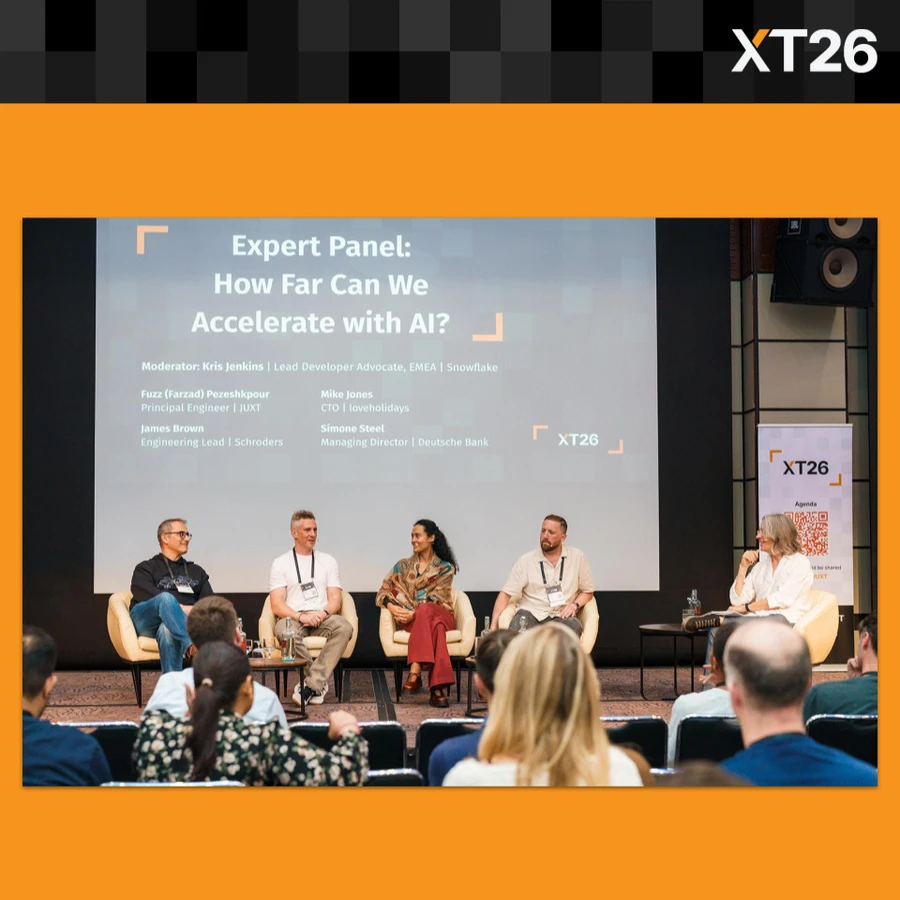
That was one of the lines that stayed with me after attending the AI panel at XT26, particularly because of how consequential that becomes when data is used to shape AI strategy. If the wrong metrics are chosen, or the evidence is interpreted too conveniently, organisations may end up scaling the wrong ideas with remarkable efficiency.
What I appreciated about the panel was its balance of sober critiques of AI adoption with genuine optimism about its potential, without collapsing into either hype or cynicism. One of the most pivotal questions was this repeated inquiry into how its value can, and ultimately should, be measured. That concern flowed into a broader theme in the discussion: AI adoption cannot be treated as a straightforward technology rollout.
Tools of this magnitude inevitably affect the intrinsic workings of an organisation, how decisions are made and how teams are structured. Without complementary social and organisational change, introducing AI may create more complexity than value. Or as Farzad eloquently puts it, “Entropy is inevitable. But so is complexity, evolution.”
They later emphasise that the complexity involved naturally makes cause and effect difficult to untangle. Much of current AI practice still rests on informed intuition, promising anecdotes and assumptions that have not yet hardened into reliable evidence. When AI is introduced into an organisation, how do we know which outcomes it actually influenced? How do we distinguish meaningful progress from activity that simply looks productive?
Simone contributes a useful way of approaching those questions: measure AI at the level of the wider system, rather than judging a tool only by the speed or quality of its immediate output. That means examining where value appears across the organisation, where complexity has been shifted elsewhere and which new costs or constraints have quietly been introduced. This felt especially valuable because it challenges the comforting simplicity of many AI success stories. A faster output is easy to celebrate; understanding what changed around it is much harder.
What I ultimately took away from XT26 was not a neat answer, but a clearer sense of the questions that matter: how we measure progress, how organisations must evolve alongside AI, and how easily intuition can be mistaken for evidence. Left with a richer context, but still an open-ended inquiry, this was amongst my favourite thought-provoking parts of the conference.