
For years, I carried a secret that felt almost heretical for a software developer: I was falling out of love with coding.
Not with building things — that spark never left. The idea of solving a problem, of turning nothing into something, still got me out of bed. But somewhere between the idea and the finished product lay a vast, draining middle. The boilerplate. The dependency hell. The three hours lost to a missing semicolon’s spiritual equivalent. The gap between what I could imagine and what I could ship had become a swamp, and I was wading through it with heavy boots.
Then something changed.
The Swamp Dried Up
I started using Claude — or Claudia, as I’ve taken to calling her — properly, daily, as a core part of how I work. Not as a novelty. Not as autocomplete on steroids. As the way I build things.
A friend — a recent graduate — had an idea for a hiring platform aimed at graduates. The kind of idea I’d normally nod along to and then quietly file under “sounds great, would take months.” Instead, I built the MVP. It took days, not months. It actually worked. And something in my brain clicked back into place.
The best analogy I’ve found is this: I used to be a one-person construction crew. Architect, bricklayer, plumber, electrician. I’d sketch the blueprint and then spend days — sometimes weeks — hauling the bricks. The creative high of the design phase would evaporate somewhere around the third day of wiring, and I’d finish the project running on discipline rather than excitement.
Now I’m the conductor of an orchestra.
I still choose the piece. I still interpret the score. I decide where the crescendo falls, where we pull back, where we surprise the audience. But I’m no longer playing every instrument myself, one at a time, badly. My job is to shape the thing, not hand-assemble it.
This Has Happened Before
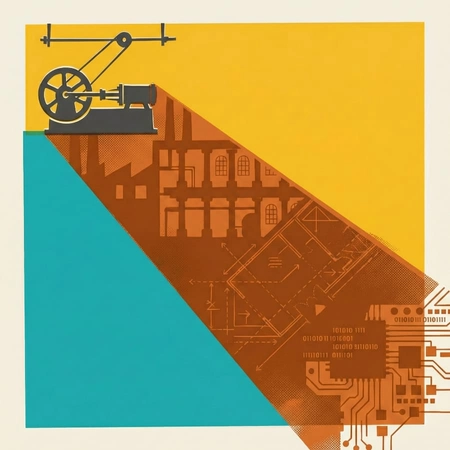
The feeling is new to me, but the pattern isn’t. In the 1980s, technical draughtsmen faced a similar reckoning. These were people who’d spent years mastering the art of precise, hand-drawn engineering plans — every line, every dimension, every annotation placed with painstaking care. A single revision could mean days of redrawing.
Then CAD arrived.
It didn’t make their knowledge obsolete. It made their hands obsolete. The understanding of tolerances, materials, spatial reasoning — all of that mattered just as much, arguably more, because suddenly you could iterate fast enough for those decisions to be the bottleneck. The draughtsmen who embraced CAD didn’t become less skilled. They became designers. They attempted things they’d never have considered when every revision meant starting over with a fresh sheet of vellum.
That’s exactly how this feels. The knowledge I’ve built over years of writing software — the instinct for where complexity hides, for what will bite you at 2am, for when a design smells wrong — none of that has become less valuable. But the hours I used to spend translating that knowledge into working code? That ratio has changed dramatically.
What Actually Changed
Here’s what a month of working this way has taught me:
Ideas are no longer filtered by implementation cost. Before, when a thought struck me — what if the system could also do X? — my brain would immediately run a complexity estimate. Two days of work? Not worth it. Move on. That filter is mostly gone now. The graduate hiring platform exists because of this. So do the Grafana dashboards I built to monitor my Tesla Powerwall and Starlink connection, the Prometheus exporters that feed them, and an energy monitoring dashboard for my campervan. None of these are big projects. All of them would have died in the “nice idea, shame about the effort” pile.
I stay in the creative layer longer. There’s a mode of thinking — architects know it, musicians know it, writers know it — where you’re holding the whole system in your head, seeing connections, making decisions that feel right before you can articulate why. I used to get maybe an hour of that before the implementation details dragged me down into the weeds. Now I can stay there for most of the day.
I solve problems I’d have walked past. That weird edge case. That UI polish. That “wouldn’t it be nice if…” feature. Not because they were impossible before, but because the effort-to-reward ratio didn’t justify it. My GitHub contribution graph tells the story — it went from mostly empty to over 800 contributions in the past few months. I’m not working longer hours. I’m just not losing entire days to the mechanical bits.
The Conductor Is Not a Passenger
I want to be careful here, because there’s a lazy version of this story where AI does the work and the developer watches. That’s not what’s happening — or at least, it shouldn’t be.
A conductor who doesn’t understand music is just someone waving a stick.
You still need to hear when the output is wrong. You still need taste, judgement, and the hard-won instinct that comes from years of doing it yourself. The domain knowledge doesn’t become less important — it becomes more important, because you’re making higher-level decisions faster, and bad judgement at that altitude compounds quickly.
The difference is that your expertise is no longer trapped behind the time it takes to implement it.
A Letter to the Disillusioned
If you’re a developer who once loved this craft and somewhere along the way started to dread opening your editor — I get it. I was there. The joy of building got buried under the labour of building, and they’re not the same thing.
The draughtsmen who resisted CAD didn’t save their craft. They lost it. The ones who picked up the new tools found they could do more of what they actually loved — the thinking, the designing, the solving — and less of what had slowly been grinding them down.
The part of you that loved this isn’t dead. It’s just been buried under the labour. And the tools to dig it out are sitting right there.